N-back is perhaps the best-known task for training working memory — and with Spielio you play it right in your browser, free and without signing up. No download, no flood of ads, no IQ promise. Just the task itself, cleanly built and easy on the eye.
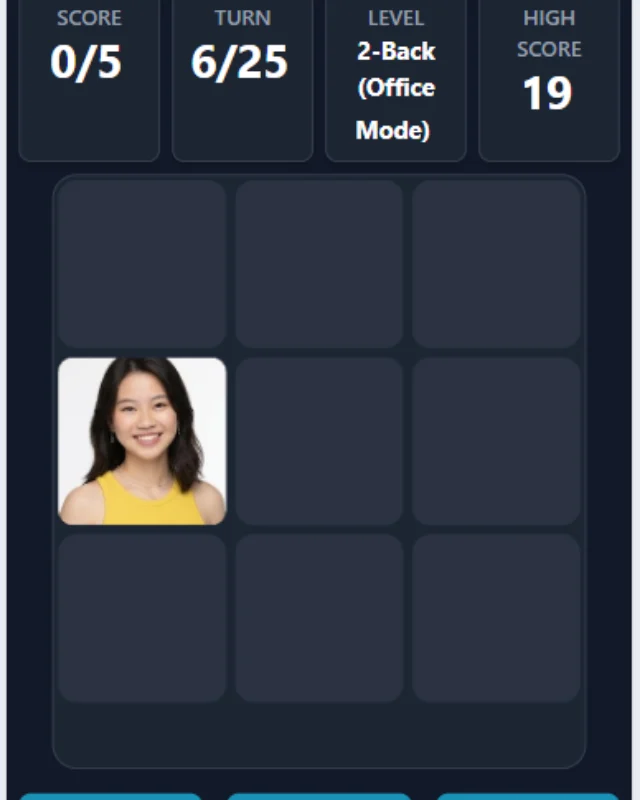
What Spielio N-Back is
A continuous stream of stimuli runs on screen. Your job: respond whenever the current stimulus matches the one that appeared N steps earlier. It sounds simple, but after a few rounds it is remarkably demanding — because your memory has to keep dropping the oldest item and taking in the newest. This holding and updating under light time pressure is the heart of the game. If you first want to understand exactly what “2-back” or “dual n-back” means, read our plain explanation of dual n-back.
Level by level
The centrepiece is the adaptive difficulty. You start low — usually at 2-back — and work your way up:
- When you do well, N rises. 2-back becomes 3-back, then 4-back and beyond.
- When mistakes pile up, it drops again, so you do not give up in frustration.
- This keeps you almost always at your edge — demanding enough to stay sharp, never overwhelming.
That sliding edge is what makes n-back so oddly satisfying: you feel your progress directly, session by session, without it ever becoming trivial.
Honestly: what it gives you — and what it does not
We do not promise you a higher IQ, and for good reason. The research is clear that regular n-back reliably makes you better at the task itself — you hold and update information measurably more securely. Whether that training also raises general intelligence is, by contrast, genuinely contested in the research. The much-cited founding study found an effect; later, more tightly controlled studies could not convincingly confirm it.
So here is our promise: n-back is a focused, demanding, beautiful workout for working memory — no more, but no less either. You will find the whole debate, properly sourced, in our honest overview: N-back training — what the science says.
Who it is worth it for
- For anyone who wants a calm, demanding mental break instead of endless scrolling.
- For anyone who likes to see their own progress — a rising N is an honest yardstick.
- For anyone who enjoys focused work and appreciates a task that asks for full attention.
How to start
Open the game, begin at 2-back and play a few rounds without staring at the score. After a few sessions you get a feel for the rhythm, and the adaptive difficulty finds your level on its own. Short, regular sessions beat rare long ones — 15 to 20 minutes across several days a week is ideal.
Play n-back now
Free in your browser, adaptive difficulty, no download — an honest workout for working memory.
Learn more
If you want to go deeper: our plain explanation shows with an example how 2-back works, and our research overview lays out honestly what training actually does.
- Kirchner, W. K. (1958). Age differences in short-term retention of rapidly changing information. Journal of Experimental Psychology, 55(4), 352–358 — origin of the n-back task
- Jaeggi, S. M., et al. (2008). Improving fluid intelligence with training on working memory. PNAS, 105(19), 6829–6833 — the dual n-back variant that popularised the task
- Melby-Lervåg, M., Redick, T. S., & Hulme, C. (2016). Working Memory Training Does Not Improve Performance on Measures of Intelligence or Other Measures of Far Transfer. Perspectives on Psychological Science, 11(4), 512–534 — an honest account of far transfer